500 Years of Genealogy And I'm Not Even 40
I tried to make sense of an Ancestry export and accidentally built a family-history instrument: radial fan charts, a migration map that changes scale as you zoom, and five centuries of paperwork in a single file that opens from a folder. I have no free time. What am I doing to myself?
- Role
- Developer, Designer, Data Visualization, Researcher
- Team
- Just me, About 800 dead relatives
- Year
- 2026-11
- Tags
- Interactive, R&D, New Technology, Development, Documentation
- Tools
- HTML, SVG, JavaScript, Python, GEDCOM, Natural Earth, GeoNames, Claude Code, GitHub
It started with a 2023 bender that resulted in too much time in Ancestry and then an export of that data: a lot of people, a lot more facts, and only annoying ways to look at it.
The big genealogy sites show you a handful of people at a time, and a hint somebody clicked "accept" on looks exactly as solid as a birth certificate. It is a lie. I wanted to see the whole thing at once, I wanted to know which parts were actually true, and I wanted it to look like something I'd hang on a wall.
Mostly I wanted to know how far I could go back in my genealogy and validate each link with documented proof rather than familial folklore (which does count for something, but isn't truthy).
So, naturally, I built my own viewer. Then I kept going for three and a half months.
Every screenshot on this page uses a made-up family. The real one has living people in it, and none of them signed a release and I'd like to think I'm pretty good about privacy.
One file, no server, opens from a folder
The whole viewer is a single HTML file. No build step, no install, no account, no cloud. Double-click it and it works, offline, straight off the disk. The family data sits in a private folder beside it and never touches a server, and it never will, because a family tree with living people in it is basically a doxxing kit with nice fonts.
That constraint ended up shaping everything. Every chart is hand-drawn SVG. The map ships its own coastlines (Natural Earth, clipped to the Atlantic and simplified) and its own gazetteer of every place the family turns up in, so there are no map tiles to fetch and nothing to break in ten years.
The fans
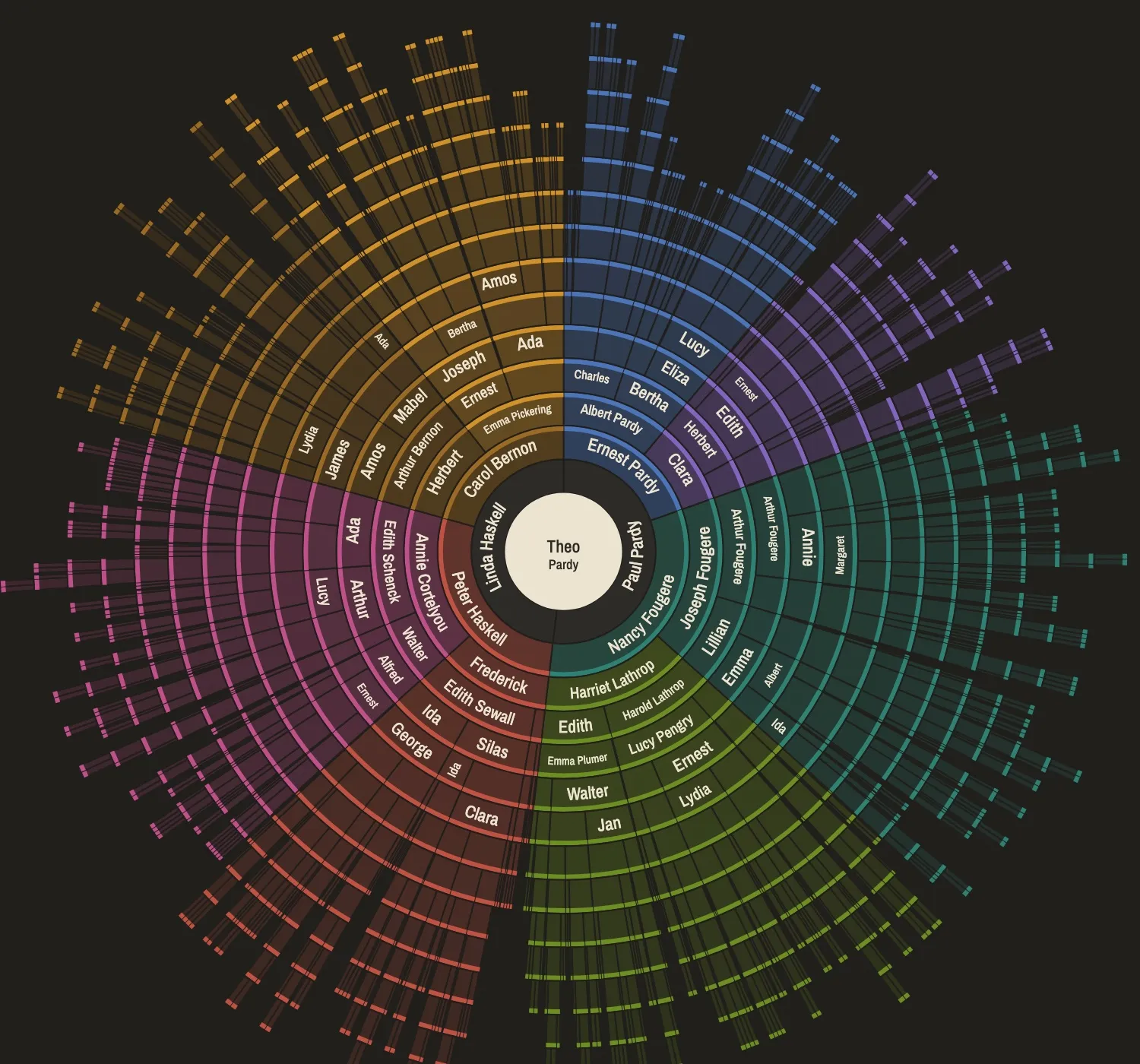
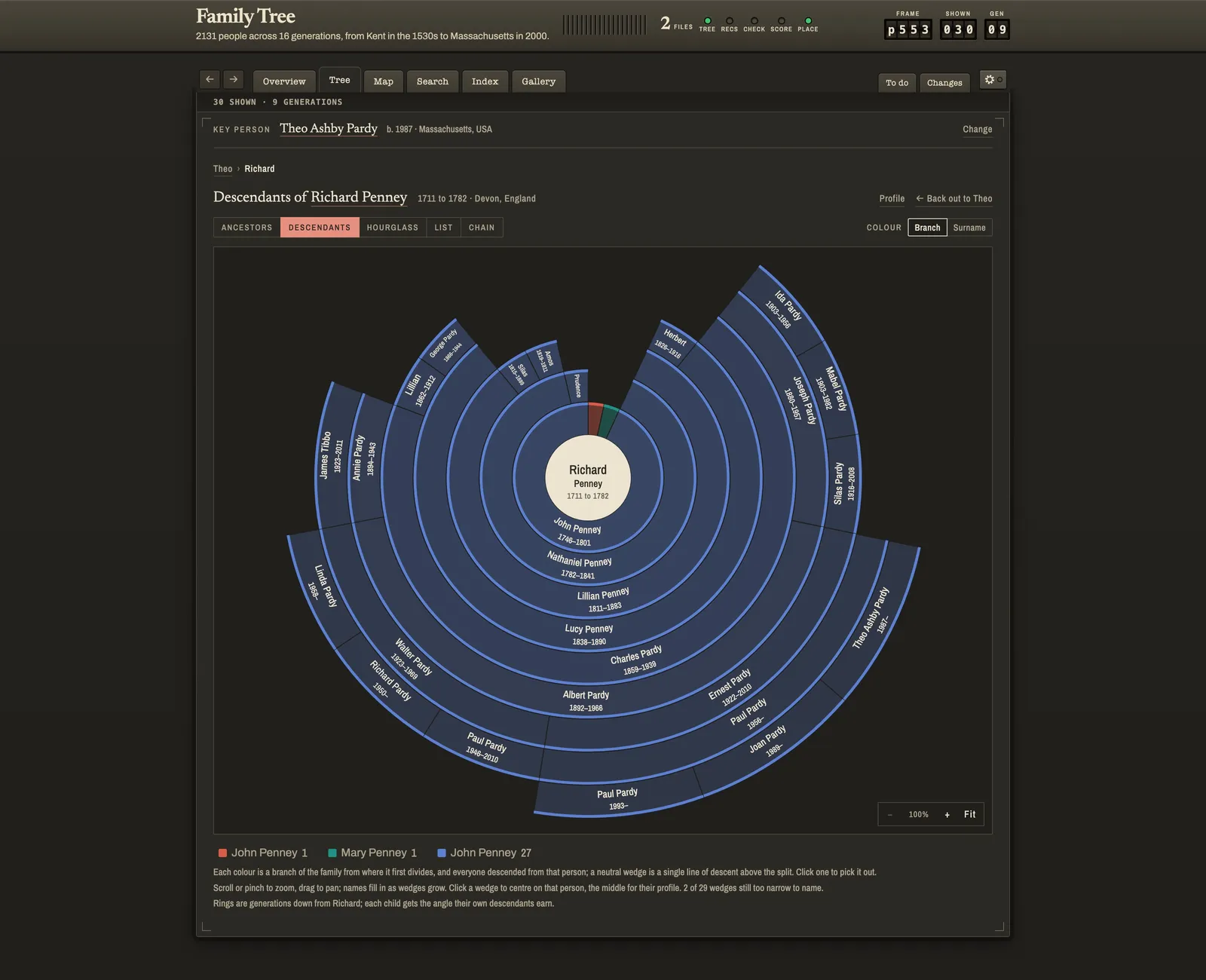
The headline view is a radial fan: you in the middle, your parents in the first ring, grandparents in the second, and out from there. Mine goes back 13 generations to an ancestor born in 1494. It's kind of like if DaisyDisk (Mac OS Utility) had a genealogy option.
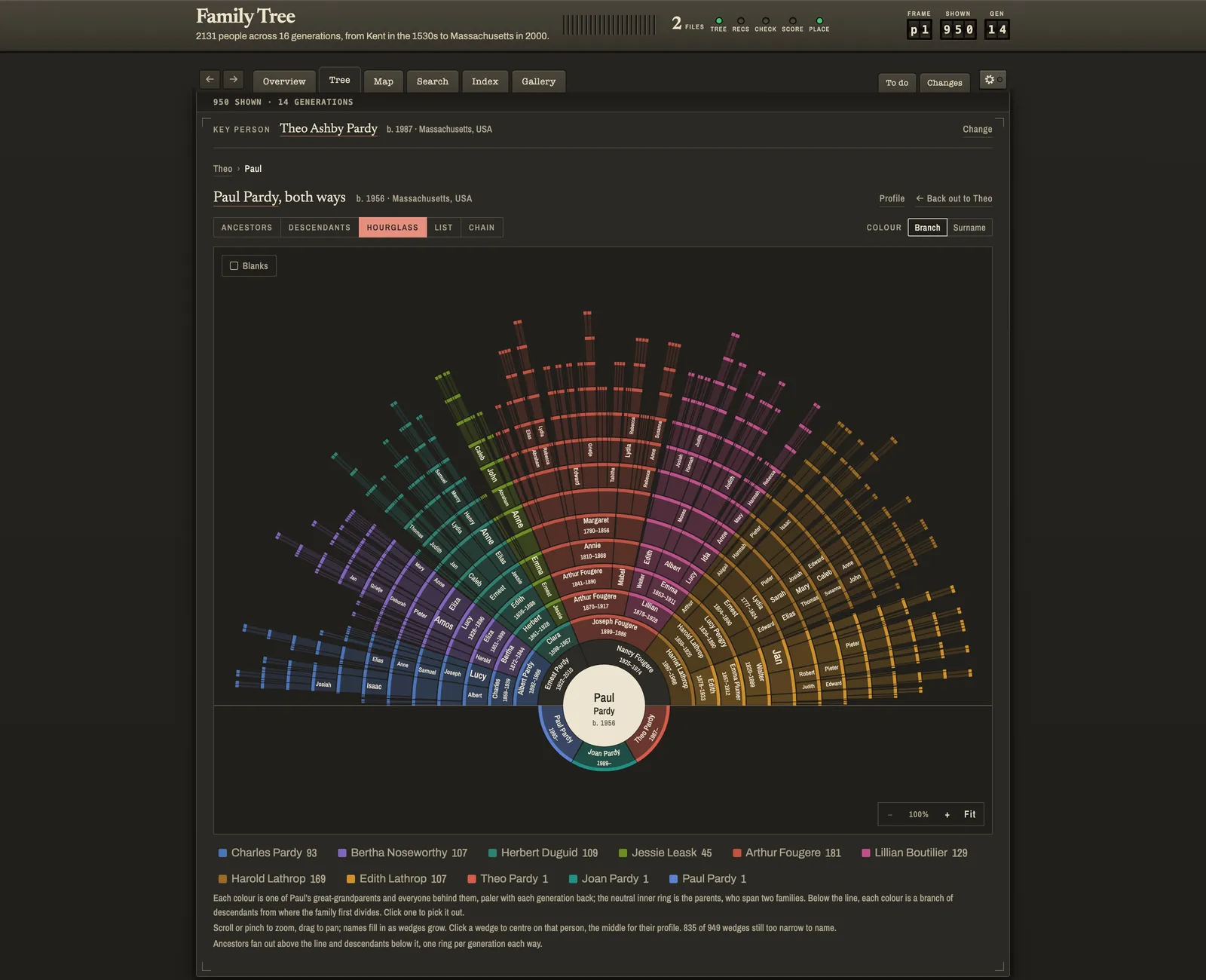
A textbook fan gives every parent exactly half of their child's slice. That's the honest reading of a pedigree, and it falls apart fast: by ring 11 a fixed fan reserves 2,048 slots for the dozen people you actually know about, and each of them gets a one-pixel wedge. So each branch gets the angle its documented size earns instead, and the wedges get wider as the tree thins out. It's the only way 13+ generations render at all, and the chart says so in its caption.
The details I sweated:
- Names run along the arc, not out from the centre. A wedge is way wider along its curve than it is thick (4.3x at ring 1), so radial labels were clipping "Ronald Blifford" to "Ronald Bliff...". Wide wedges get flat text instead, because curved text at 3 o'clock reads vertically.
- Labels are chosen per zoom level. A wedge grows from nothing, to a first name, to a full name with dates as you zoom into it.
- Color by branch: each of your eight great-grandparents gets a hue that carries all the way to the rim. Or color by surname, with spelling variants sharing a color, because nobody in 1740 could agree how to spell anything. Or spell anything... at all!
- The surname palette is validated for color-blind separation, and it's never faded with transparency, because fading it wrecks that separation. The muted body text clears WCAG AA. Yes, on a family tree. I'm aware. Just in case I want to look at it after my eyesight goes, I guess.
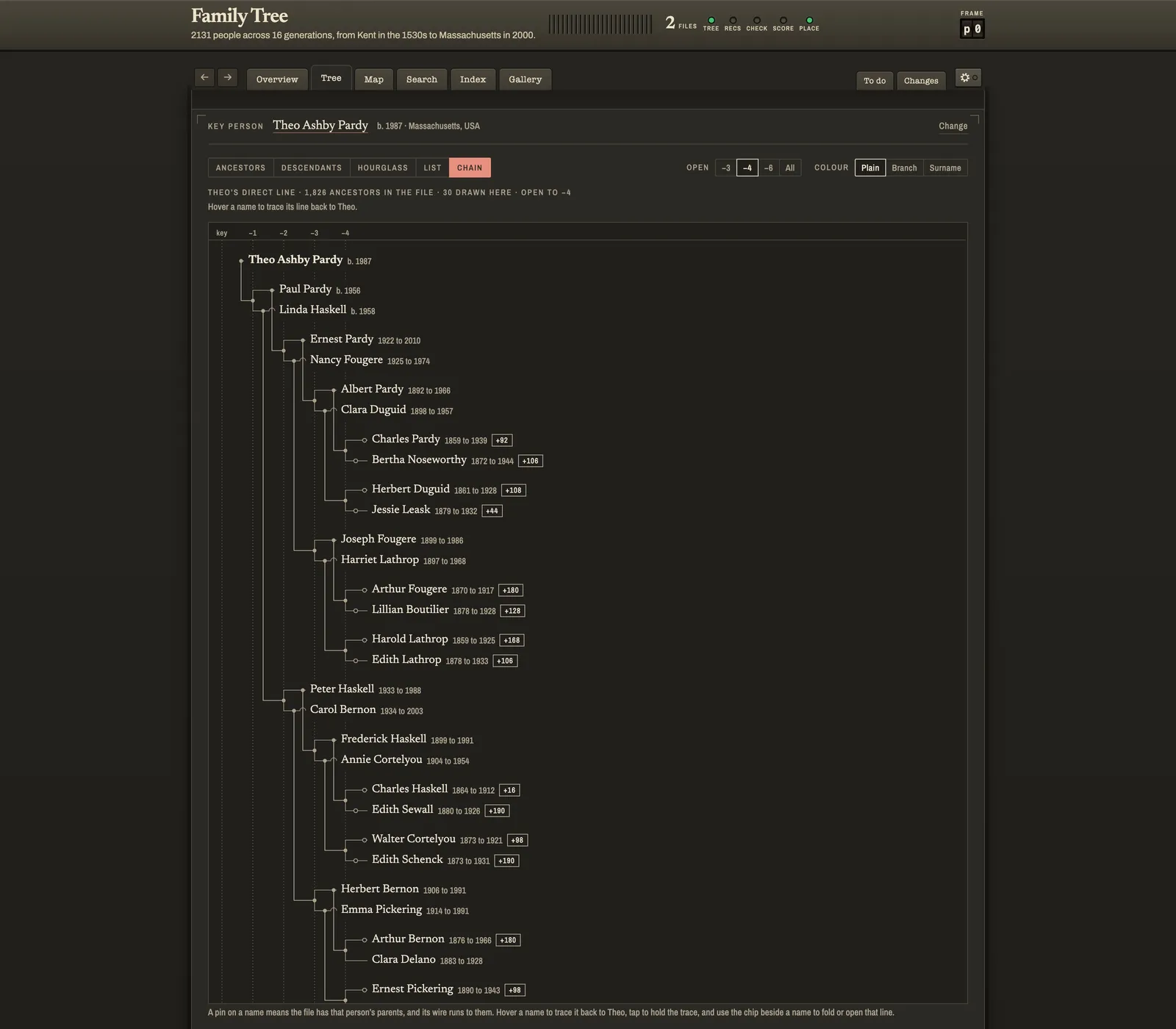
Five charts total: Ancestors, Descendants, Hourglass, an outline List, and Chain, which is my favorite. It draws your ancestry like a schematic. Hover any name and its line back to you lights up in oxblood and spells itself out.
The map
The other big one is "Atlantic crossings": a migration map where circles are places, sized by how much life happened there, and arcs run from a parent's birthplace to a child's. In my case it's a lot of England and Scotland and the Netherlands, a long stop in Newfoundland and Nova Scotia, and then everybody washing up in Massachusetts and Maine.
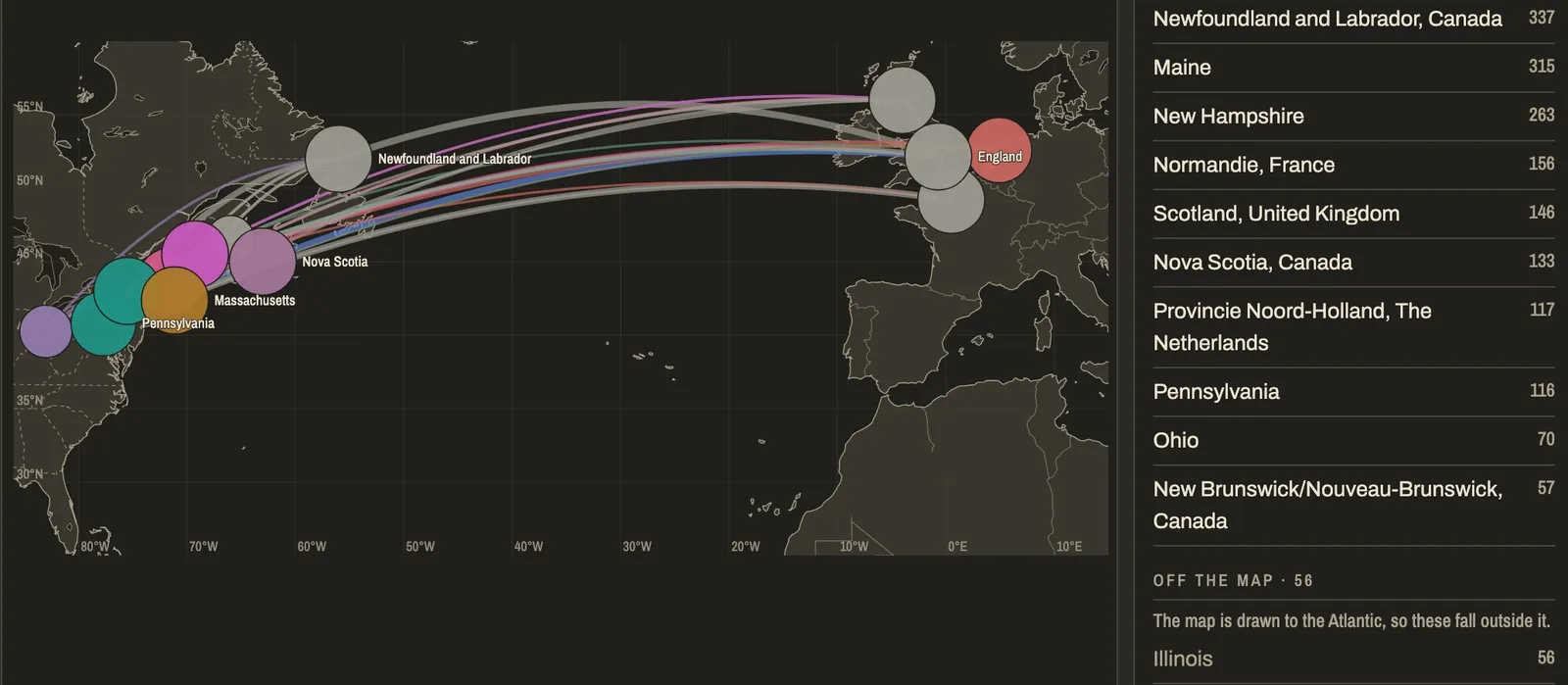
Zoom changes the unit. At the ocean scale the map draws states and countries, around 180% it splits into counties, and around 450% into towns. A coarse dot absorbs everything inside it, and the arcs follow. And zooming never invents detail: if a record only says "Essex, Massachusetts", that person stays on the county dot no matter how far you zoom, and the panel tells you how many of those there are.
It also plots where people lived, not just where they were born and died. Census entries get drawn as the decade they stand for, and a time slider replays the whole thing. Births and deaths accumulate, since a dated fact stays true, but a residence fades back out once the family moves on.
Checking the receipts
This is the part that turned a weekend into a season. The viewer tracks what has actually been verified, fact by fact, against the same proof standard professional genealogists use. Every birth, death and parentage is either documented by a record, proved indirectly by several records together, probable, or still open. The fan can grey out anything nobody has checked, so you can see at a glance how much of your tree is real and how much is vibes.
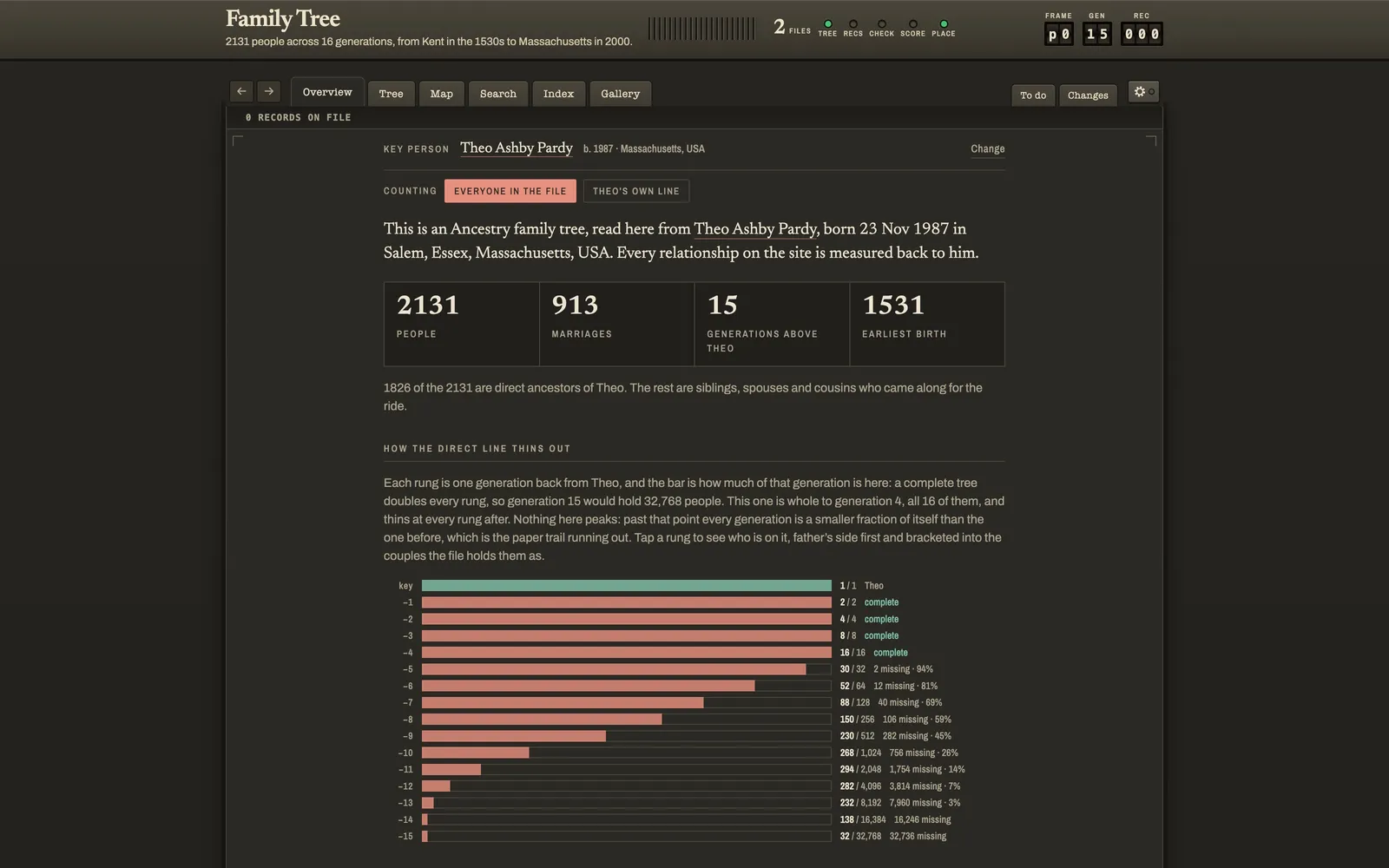
Behind it is a scan viewer for the old documents (deeds, census pages, church registers) with reading presets for faded ink, stained paper, pencil and negatives. Every profile carries its records, notes and sources. And some of the paper trail just isn't online at all, so there are genuine requests sitting with real archives right now, waiting on someone to pull a card from a drawer. Extremely 1994. I love it.
Things I learned the hard way:
- People spelled their own names three different ways, and the clerk picked a fourth.
- A deed from the 1830s can be the only document on Earth that says who somebody's parents were. Deeds also say where the buyer lived, which is how you trace a family moving west one town at a time.
- A cemetery can be full of your people and almost invisible online. Some of mine are only findable on index cards in a city archive.
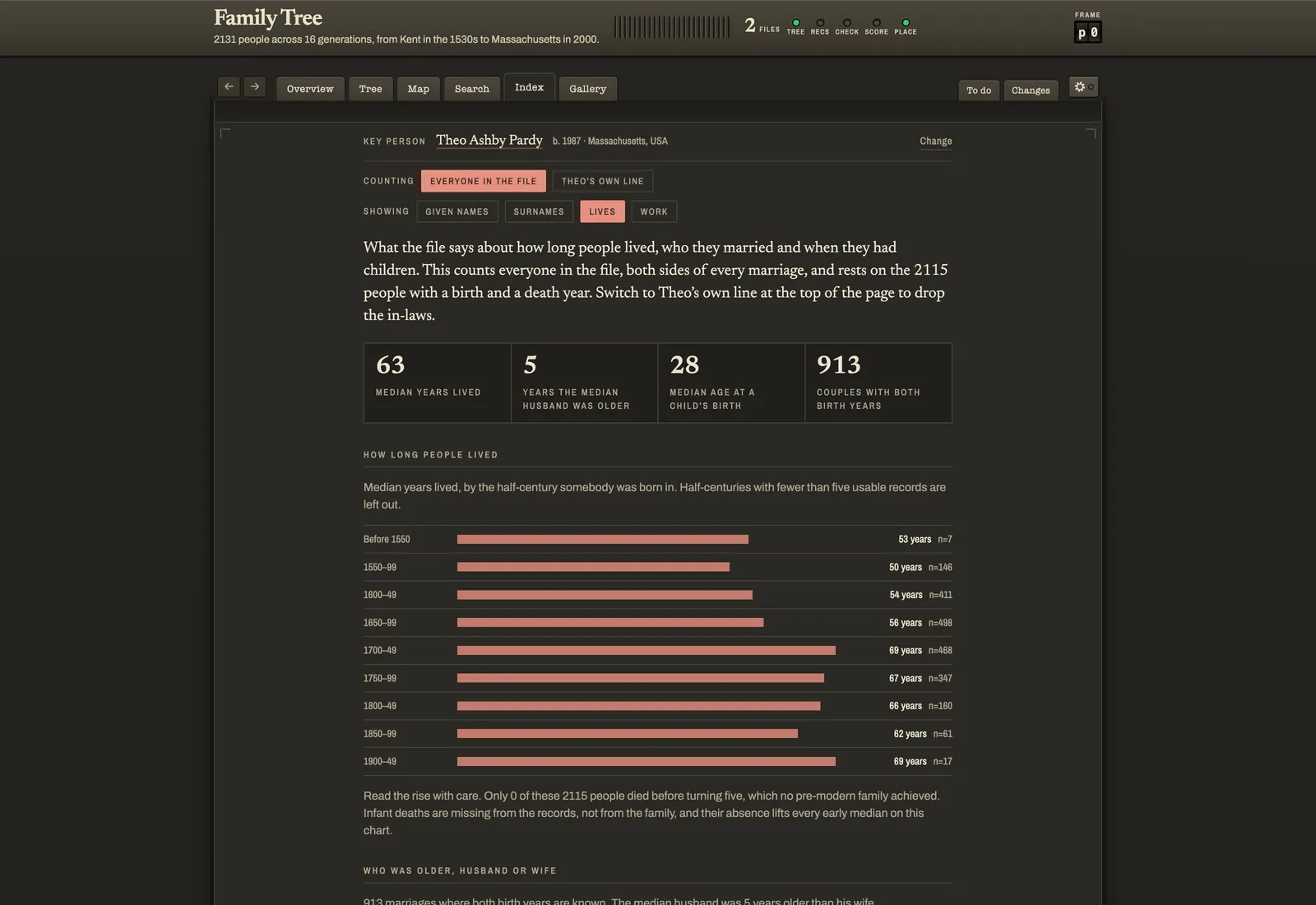
Alright, let's do the numbers 🌳
- 1 HTML file
- 0 servers, 0 dependencies, 0 accounts
- 807 people
- 13 generations, back to 1494
- 5,000+ record files filed against profiles
- Nearly 200 family portraits
- 5 tree charts, 1 map, 1 scan reader
- 3 zoom levels of geography (state, county, town)
- Records requests out to real archives, like it's the olden days
- 397 commits in three and a half months 🫠
Built with: plain HTML, CSS and JavaScript with hand-drawn SVG and no framework, plus a pile of Python for importing, cleaning and filing the data. Coastlines and borders are Natural Earth (public domain), place names and coordinates are GeoNames (CC BY 4.0). Thanks to every county clerk, cemetery volunteer and parish priest who ever wrote anything down 🙏
Project Gallery
1 / 7